Entrepreneurship Education Reimagined: Innovation For a Just and Sustainable Future
· entrepreneurship education, sustainability, pedagogy, green economy, ESD, SDG 4.7
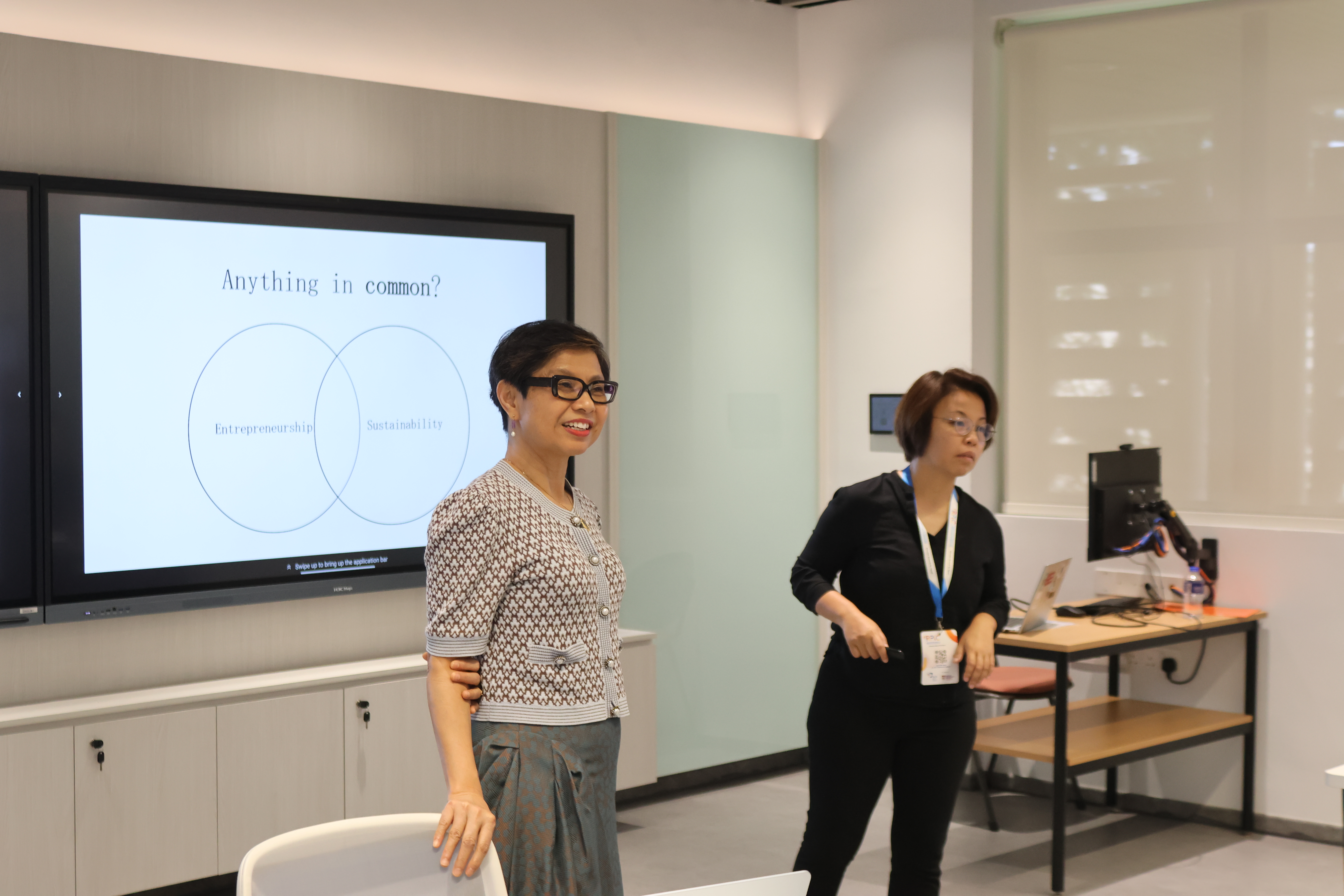
At the Redesigning Pedagogy International Conference 2026, held on 4 June at the National Institute of Education (NIE), Associate Professor Liu Lerwen, Founder of the Human Centred Sustainability Research and Education Lab Group, and Ms Lim Li Yin delivered an engaging and thought-provoking session on reimagining entrepreneurship education for a more just and sustainable world.
Discovering Common Ground
The session opened with a simple but revealing exercise by Ms Lim Li Yin: participants were asked to free-associate words with "entrepreneurship" and then with "sustainability." The results were telling — entrepreneurship conjured ideas of startups and money, while sustainability brought up climate change, long-term thinking, and green solutions. At first glance, the two fields seemed worlds apart. Yet through guided table discussions, participants began uncovering striking common ground, most notably, problem-solving and value creation. This set the tone for a session that would challenge long-held assumptions about what entrepreneurship education can and should be.
A Historical Perspective
Assoc Prof Liu Lerwen offered a brief historical overview, tracing how entrepreneurship education emerged as a relatively recent discipline — a direct response to the knowledge-based economy — and how it has since faced growing pressure to become more socially conscious. The rise of corporate social responsibility, social entrepreneurship, and the UN’s Education for Sustainable Development (ESD) framework, formalised through SDG 4.7 in 2015, have all pushed educators to reconsider the purpose of entrepreneurship in the curriculum.
In Singapore’s context, this tension has been felt since 2015, as schools at every level have sought to cultivate more enterprising and innovative graduates.
The HCSREL Approach
What makes the HCSREL approach distinctive is its insistence on integrating sustainability not as an add-on, but as a foundational lens. Ms Lim shared how students are brought into unconventional learning spaces, such as a visit to Changi Village’s House of Melissa — a social enterprise combining hospitality, bee rescue, composting, and nature-based solutions.
Encounters like these spark what the presenters describe as a paradigm shift: students begin to see entrepreneurship not as “doing something cool with a startup,” but as being deeply embedded in community, ecosystems, and long-term responsibility.
Measurable Impact
Survey data gathered before and after the course supported this transformation. Students showed significant increases in entrepreneurial confidence, risk-taking willingness, opportunity recognition, networking ability, and resilience — all hallmarks of an entrepreneurial mindset but now framed within a sustainability context.
A Call to Educators
The presenters closed by invoking educator David Orr’s idea that all education is, at its core, environmental education. Every choice of what to teach, and what to leave out, communicates something about our relationship with the natural world.
Their message to fellow educators was clear: if we want the next generation to build businesses that truly serve humanity, we must start by asking not just “how do you succeed?” but “what are you here to do?” Entrepreneurship education, reimagined with justice and sustainability at its heart, may be one of the most powerful tools we have to answer that question.