From a Bar Trick to Abu Dhabi: How One Founder’s Ethos Scaled Across Every Business Model
· ASEAN, Miniwiz, B2B, B2C, B2G, entrepreneurship, circular economy, NTU, SDG 12
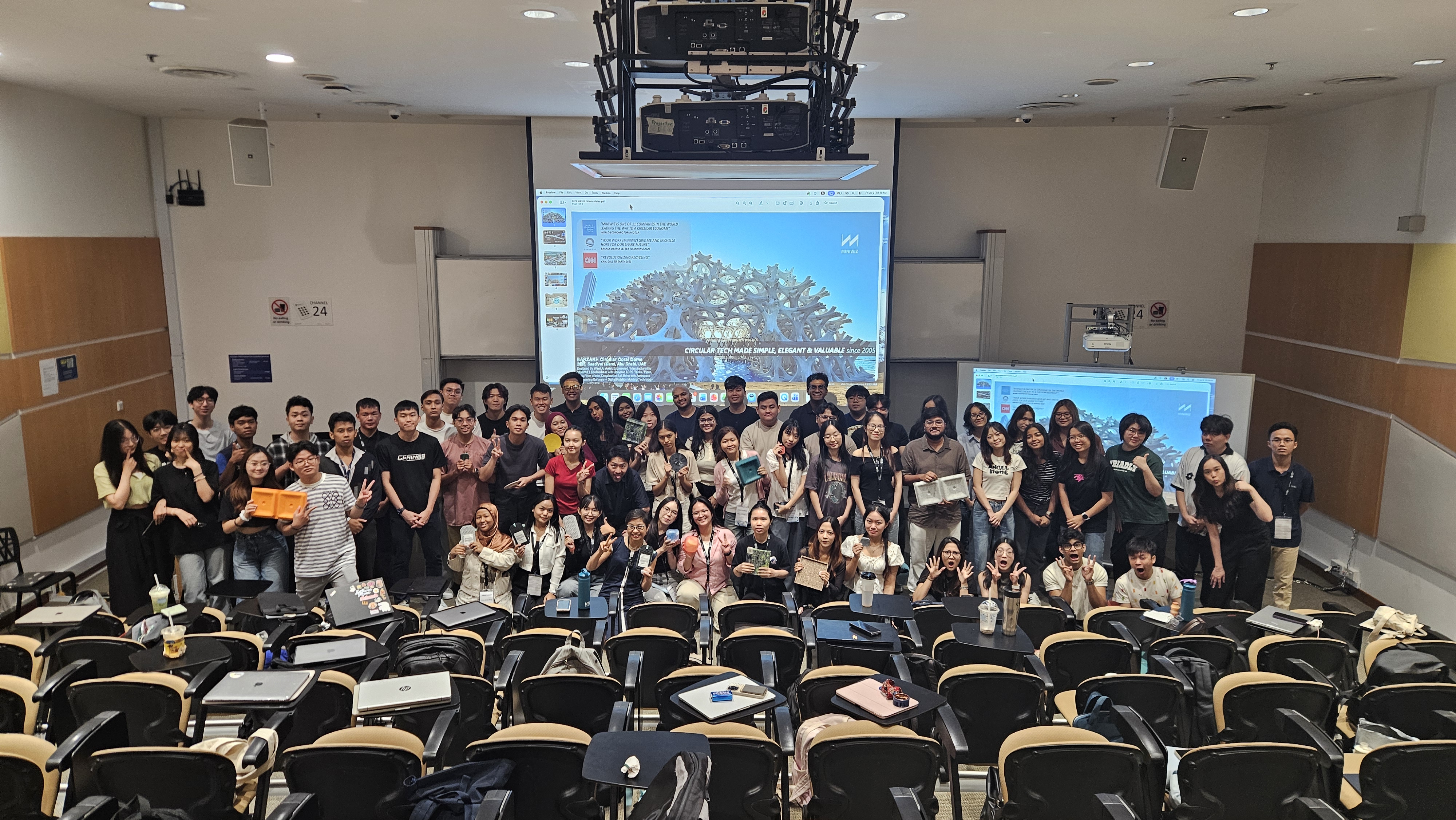
Day 5 of ASEAN Summer Track 1 Program on Venturing into Entrepreneurship was the 2nd lecture by mr Arthur Huang, CEO of Miniwiz delievred a talk built around his own career which was held at Lecture Theatre 4, School of Physics and Mathematical Sciences (SPMS), NTU. Arthur walked the students through the three core business models of B2C, B2B, and B2G, with a live product-making demonstration and open Q&A as the day’s central activity.
His key message was that a founder’s ethos, in his case a strict commitment to zero waste, has to remain non-negotiable no matter which business model is being pursued, since it is that consistency which eventually builds trust, credibility, and long-term opportunity.
B2C: The Bar Trick That Became a Product
Arthur’s talk moved through his three business models largely in the order he experienced them himself, starting with B2C. His first product, a handheld wind-and-solar phone charger made from recycled ABS plastic, was born directly from his zero-waste ethos and eventually appeared on Wired Magazine’s list of hottest new products, generating 2.8 million dollars in revenue within fifteen months.
He explained that the product’s size, its glow-in-the-dark function, and its recycled material were not arbitrary design choices but deliberate decisions built around how people behave socially, particularly in settings like bars, where the product was meant to spark conversation and attention. Scaling it required him to personally solve problems that had no existing infrastructure at the time, from looping international bank payments to pitching to journalists at CNN and Time directly.
B2B: A Brief Contrast
B2B was mentioned only briefly, since most students already understood it from their home markets, and it served mainly as a contrast to the newer B2G model Huang wanted to introduce.
B2G: Building Ecosystems in Abu Dhabi
His B2G example, centred on a project in Abu Dhabi, showed a shift in scale entirely: rather than selling a single product to a single customer, he built infrastructure and an ecosystem that created value for the government and the broader community simultaneously.
It was this shift from product to ecosystem that Assoc. Prof. Lerwen picked up on this as her key takeaway. She framed B2G not as a niche model but as a coming opportunity for a new generation of entrepreneurs, arguing that governments and large corporations increasingly shape global outcomes together, and that engaging governments directly is one way entrepreneurs can retain agency rather than be shaped by forces outside their control.
Associate Professor Lerwen Liu’s Takeaway: Ethos Transcends Industry
Assoc. Prof. Lerwen, who facilitated the session, connected Arthur’s zero-waste ethos to her own field of aerospace and nanosatellite design, where every material and design choice must be efficient and failure-proof, reinforcing her point that an authentic ethos is not industry-specific but a mindset that carries across any field once it is genuinely adopted.
Her closing message encouraged students to define their own non-negotiable values early and to treat entrepreneurship, much like Arthur’s, as a long game built on consistency rather than any single win.