From Purpose to Impact: Day 2 of the ASEAN Summer Track 1 on Venturing into Entrepreneurship
· ASEAN, entrepreneurship, SDG 12, summer workshop, Business Model Canvas, NTU
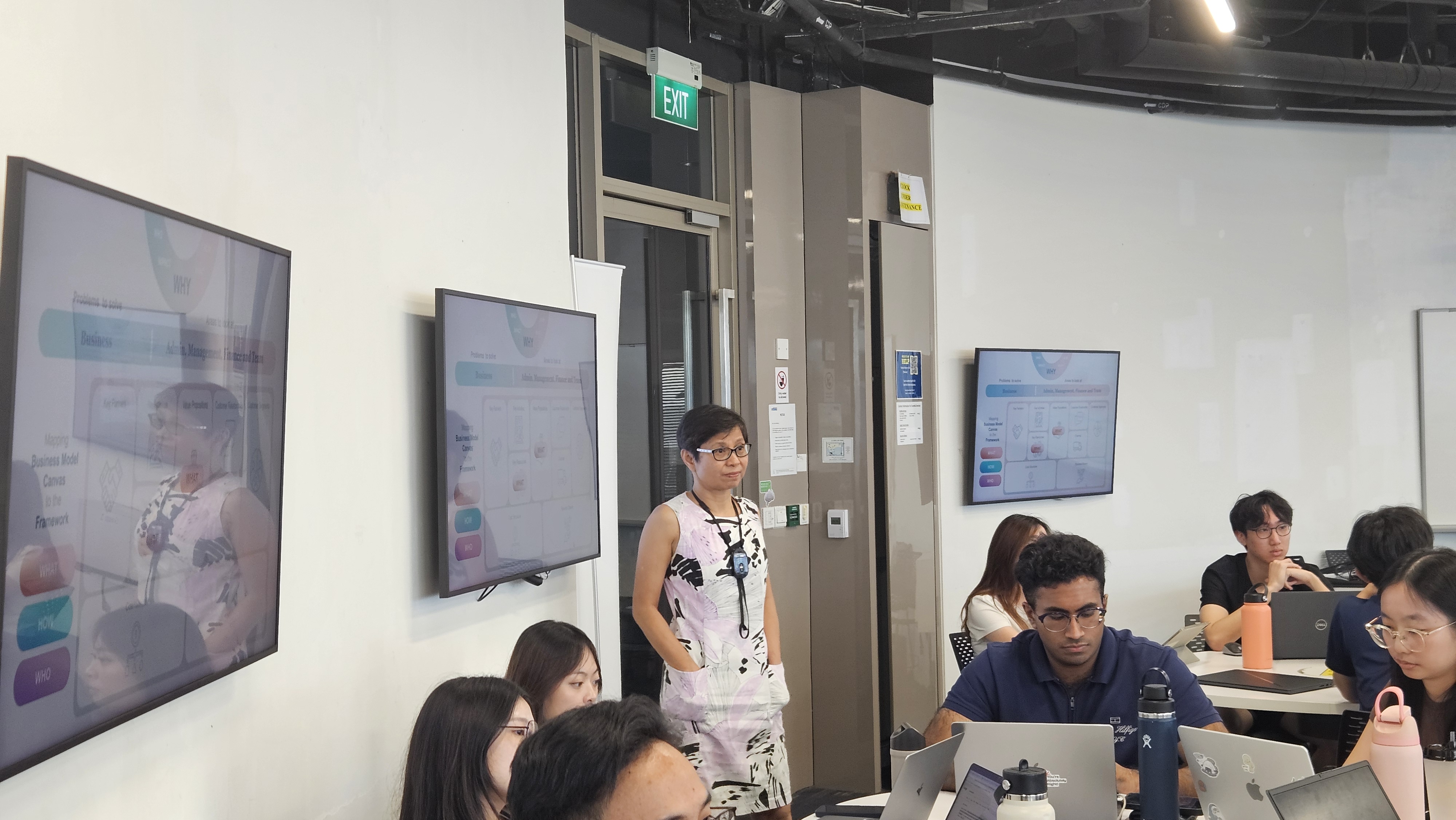
Day 2 of ASEAN Summer Track 1 program on Venturing into Entrepreneurship was an interactive session led by Associate Professor Lerwen LIU, built around a five-part framework — Why, What, How, Who, and Impact — mapped onto the Business Model Canvas to give students a practical lens for building a startup. Assoc. Prof. Lerwen's key message was that entrepreneurship is not about memorizing frameworks; it is about asking sharper questions, understanding your market and stakeholders, backing up good intentions with real data, and having the courage to act. Students learned to move from an abstract purpose to a concrete, evidence-based business model. Highlight of the day was a Cambodian participant's story of co-founding a consumer product startup, from sourcing a manufacturer in China, funding it herself, and selling to Gen Z via Instagram and her motto was "If you have an idea, execute it", which brought the entire framework to life as something achievable, not just theoretical.
The Framework in Brief
The session walked through each dimension in turn. Why pushed students to identify their core purpose and goal before anything else, since a founder without a clear "why" struggles to make consistent decisions under pressure. What focused on defining a precise value proposition, the real-world felt need that a product or service solves. How covered the operational engine: key activities, resources, marketing channels, revenue streams, and cost structure. Who expanded beyond the end customer to the full stakeholder ecosystem, customer segments, relationships, channels, and key partners. And Impact was framed as non-negotiable: students were told that impact must be quantified through desktop research, market research, and direct data collection — good intentions alone do not count.
Sao Socheata, a Cambodian student startup story, served as a live case study of the entire framework: a clear why (a product she believed in), a defined what (a tested physical product), a how (direct manufacturing and social media), a who (Gen Z consumers, with B2B potential), and impact grounded in actual sales data. For classmates still in the ideation stage, her example made the abstract framework feel tangible and within reach.
Looking Ahead
The session closed by previewing the rest of the week, which would move beyond lectures into direct engagement, which involves interviewing real founders, including NTU students who built businesses on campus, and meeting industry figures such as Mr Arthur Hwang, CEO of Miniwiz, noted as a leading voice in sustainability and the circular economy. Students were encouraged to prepare questions and treat every site visit as a chance to gather insight no textbook could offer.