Hands On, Open to All, Built Together: Growing Next-Gen Innovators for the Green and Digital Transitions
· circular economy, sustainability education, industry partnerships, AI, higher education
3 November 2026, Bali
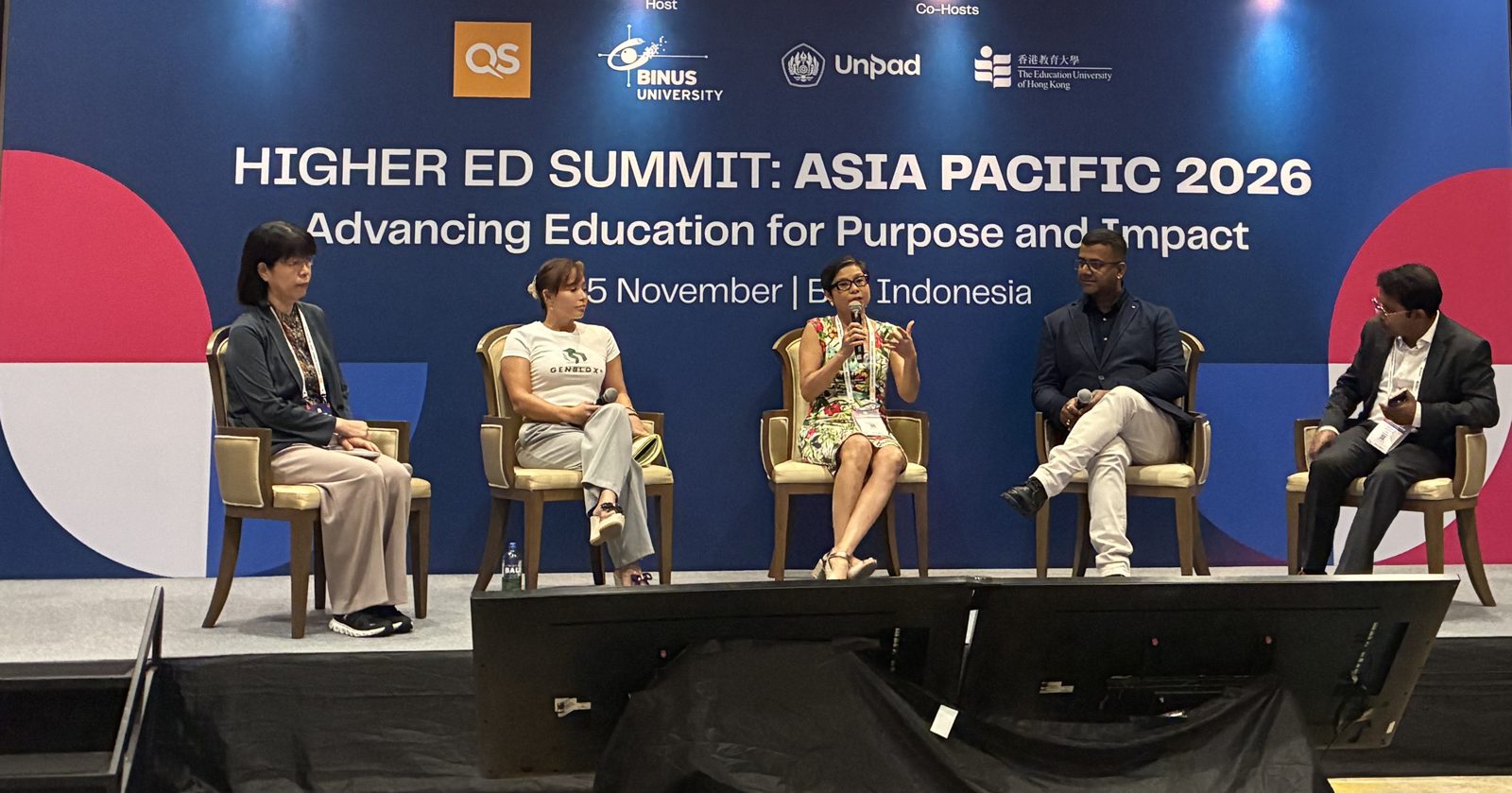
On 3 November, the QS Higher Ed Summit: Asia Pacific 2026 in Bali hosted the panel "Empowering Next-Gen Innovators: Industry Partnerships for Green and Digital Transitions". It was moderated by Prof Lerwen LIU, Associate Professor, Entrepreneurship, at NTU, who leads HCSREL.
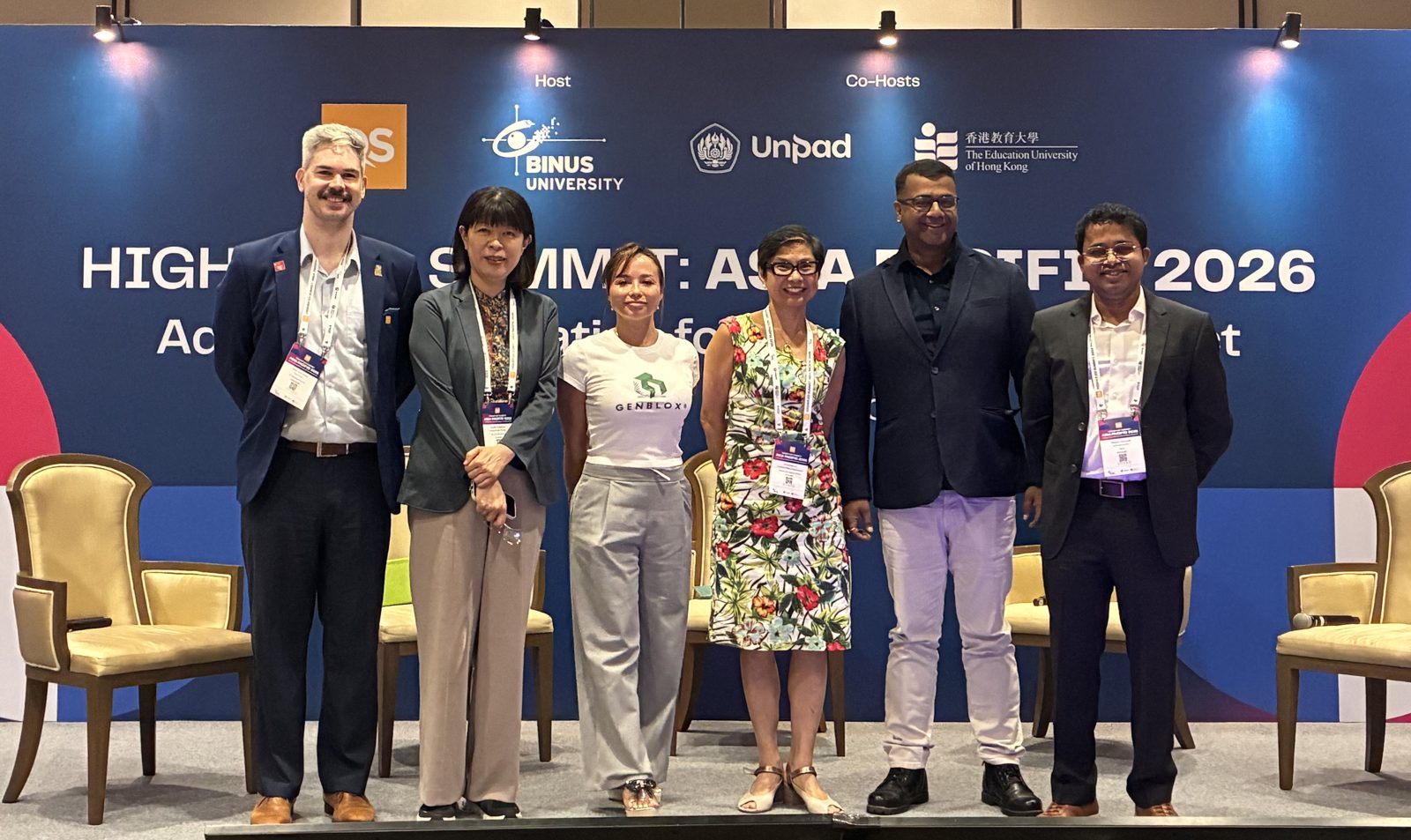
Tying the session to the summit's theme, "Advancing Education for Purpose and Impact", Prof LIU said the goal is to help young people "find purpose" so that they "can live a meaningful life and creating impact", and to let everyone in the room "co-learn together and co-create solutions." Joining her were Yumiko YAMAKAWA, Principal Education Specialist at the Asian Development Bank (ADB); April Mei Ling PORTEOUS, Founder of GENBLOX; Shayak MAZUMDER, Co-Founder and CEO of Adya AI; and Sourav ROY, President of TSL Business School.
Her first answer to how purpose becomes practice was simple: get your hands on the problem.
Learning by doing, physical and digital
"We generate so much waste every single day," Prof LIU said. The aim is to upcycle "materials that actually could replace the virgin material, which means we stop exploiting the earth."
Ms PORTEOUS showed what that looks like on the ground. Starting from Phuket's waste problem, GENBLOX now runs a maker space where guests, schools and communities learn "how to turn trash to treasure", pressing milk bottles, bottle caps and crisp packets into items such as sunglasses. "We want to go back to basics, where we allow the community to get their hands dirty and see upcycling and experience it… for themselves."
At NTU, Prof LIU said, an industry partner's Trashpresso machines, AI and robotics help teach the circular economy and STEM. The point, she said, is to "teach fundamental principles, first principle, and… teach something that AI cannot teach us": "the physical and the digital together."
The digital half is just as practical: students on the Adya AI and TSL programmes build AI agents listed for industry. As Mr ROY put it, "it's not just a college project… these are real products."
He then linked the two halves: "from trash to treasure… AI builds all the physics, heart makes the metaphysics." That raised the next question: who gets to learn this way?
Opportunity for every student
Prof LIU turned the panel to access to education, noting that many young people in countries such as India still struggle to reach higher education.
For Mr ROY, "it's not just about democratizing information, it's also about democratizing opportunity." TSL brings in "tier two, tier three level kids" from villages and deserts, and gives them "everything that a rich kid could get, everything that a privileged kid would have." A student from a Himalayan village can now build an anti-money-laundering agent for a bank. Such students, he argued, "do not need to be enslaved into another job. They need to be given that power to start something".
Mr MAZUMDER shared the same human-centred view: "we have to create a new world where AI and humans will work together." His first thought, he recalled, was "how do I give this exceptional power to the students?… I don't want to lock them into one AI." The aim: "We want everybody to benefit, so the impact should be universal."
Opening that door is more than any one school or company can do alone, and this is where the panel converged.
Building it together
Prof LIU closed with a call for partnership: if everyone worked together "to accelerate impact and purpose", what mechanisms would help "align our purpose"?
Ms YAMAKAWA explained that ADB is more than a lender: "we are the financier, but at the same time, we also… call the ADB a knowledge partner." Linking research to industry, she said, is "a common challenge across Asia and Pacific". She pointed to "the triple helix model", in which government sets the enabling environment, "the policy and regulation". "That's why the ADB wants to develop the partnership ecosystem."
Ms PORTEOUS agreed: "we can all achieve a lot more at a quicker timeline if we partner with everyone in their own expertise and areas." A technology partner handles her patents and certifications; universities help "for testing, for continuing the innovation". She was also realistic: "The government will only support you at the initial launch", so ventures must become profitable to last.
Mr ROY added that "partnerships are like marriages", lasting only with "truth, simplicity, and love".
What it means for HCSREL
For HCSREL, those answers describe the work we do every day.
Hands-on learning drives our challenge-based circular-economy and STEM education, which turns waste, data and AI into real solutions.
Opportunity for all is in our name: as a human-centred lab, we adopt technology to widen who gets to innovate.
Partnership is our role as an NTU-based ecosystem hub, a searchlight and megaphone connecting the ADB, industry, universities and communities, backed by rigorous Sustainability Impact Assessment so that the solutions we scale are proven.
Co-learn, co-create
The panel began with a call to co-learn and co-create, and ended by showing how. HCSREL welcomes partners who share that purpose: get involved.