Laying the Foundation: Discovering Your Entrepreneurial Mindset — Day 1 of the ASEAN Summer Track 1 Program
· SDG 12, ASEAN Summer Workshop, Responsible Consumption and Production, Entrepreneurship Education, Circular Economy, NTU
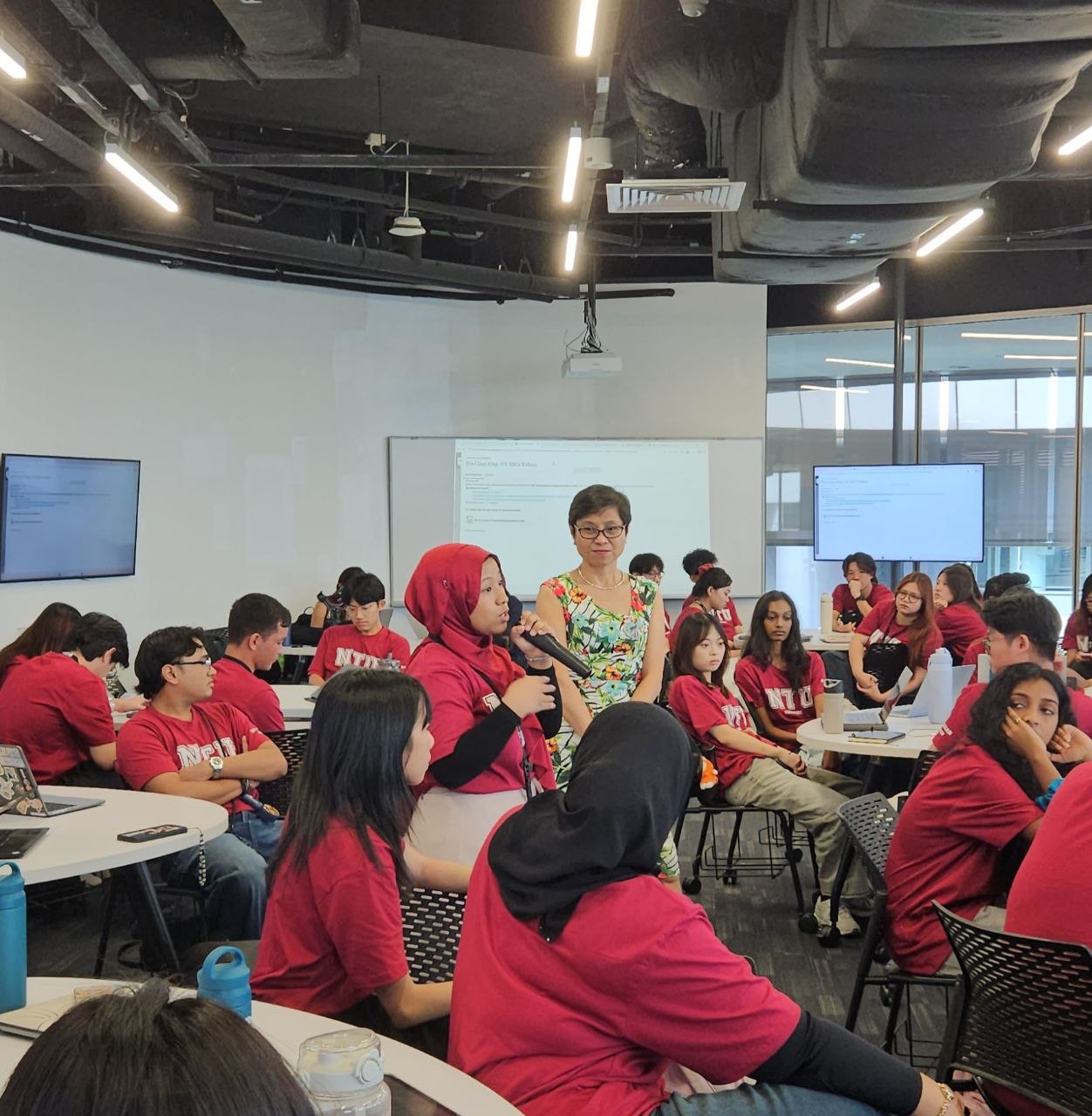
On 29th June 2026, ARC Tutorial Room 36 at Nanyang Technological University, Singapore, is host to a two-week ASEAN Summer Track 1 Program on Venturing into Entrepreneurship with a spotlight on Sustainable education, delivered by Associate Professor Dr Lerwen LIU, NTU Entrepreneurship Academy.
On Day 1 of the workshop, the focus wasn't on brainstorming neither problem nor solutions — it was on something more fundamental: helping students discover their mindset and to help them find out what they genuinely care about. Students were grouped not by topic or skillset, but by what motivates and drives them. The guiding idea is simple but rare in problem-solving education: don't rush to fix something, first sit with the problem you want to solve.
Many students gravitated toward issues rooted in their own lives — things involving family, friends, or themselves that often get quietly overlooked. Assoc. Prof. Dr Lerwen's approach nudges them to look inward before looking outward, to find like-minded peers, and only then begin narrowing that shared concern into a focused area of work. It's a small shift in sequence, but it changes the entire texture of the work that follows.
Starting from the heart, not the whiteboard
It's a familiar habit in problem-solving Entrepreneurship education to leap straight to solutions — to treat a problem as a puzzle waiting to be cracked. Assoc. Prof Lerwen deliberately resists that instinct. On Day 1, students weren't asked "what can you build?" but "what do you actually care about?"
Effective entrepreneurship education begins by uncovering students' mindsets, values, and motivations—understanding what genuinely drives them lays the groundwork for meaningful collaboration. That distinction shaped everything that followed. Students were encouraged to reflect honestly on their own experiences — moments involving their families, friends, or themselves — particularly the kinds of issues that tend to get overlooked or quietly accepted as "just how things are." Students were grouped through organic networking rather than fixed, pre-allocated teams. This approach allows like-minded individuals to connect and work together effectively, while also exposing them to a greater diversity of perspectives. The workshop's premise is that real motivation doesn't come from being assigned a topic; it comes from recognising something you've personally felt the weight of.
What stood out was watching students act on what they cared about, rather than what seemed impressive or tractable. When an interest is genuine, it tends to deepen into something closer to passion — and that passion becomes the real driver of the work ahead.
Once students had reflected on their own "why," they were grouped with others who shared similar concerns, even if their personal stories differed. This wasn't about matching people to a fixed project brief; it was about letting shared concern be the organising thread, so that the resulting group already had built-in motivation rather than motivation that needed to be manufactured later.
Narrowing down, with guidance, not direction
With like-minded groups formed, Assoc. Prof. Lerwen's role shifts to helping students narrow and streamline a broad concern into a workable area of focus — without losing the personal stake that brought them there in the first place.
They're choosing to stay with something they care about, from the heart, and the "area of focus" that emerges is a refinement of that care, not a replacement for it. It's this groundedness — caring about the problem rather than merely solving it — that the workshop is designed to protect, even as the work becomes more structured over the coming two weeks.
Stay tuned for updates on upcoming dates.