One Man's Trash, Another Man's Treasure: Inside Arthur Huang's Miniwiz Playbook at the ASEAN Summer Track 1 Program
· ASEAN, Miniwiz, circular economy, entrepreneurship, upcycling, Trashpresso, NTU, SDG 12
One Man's Trash, Another Man's Treasure: Inside Arthur Huang's Miniwiz Playbook
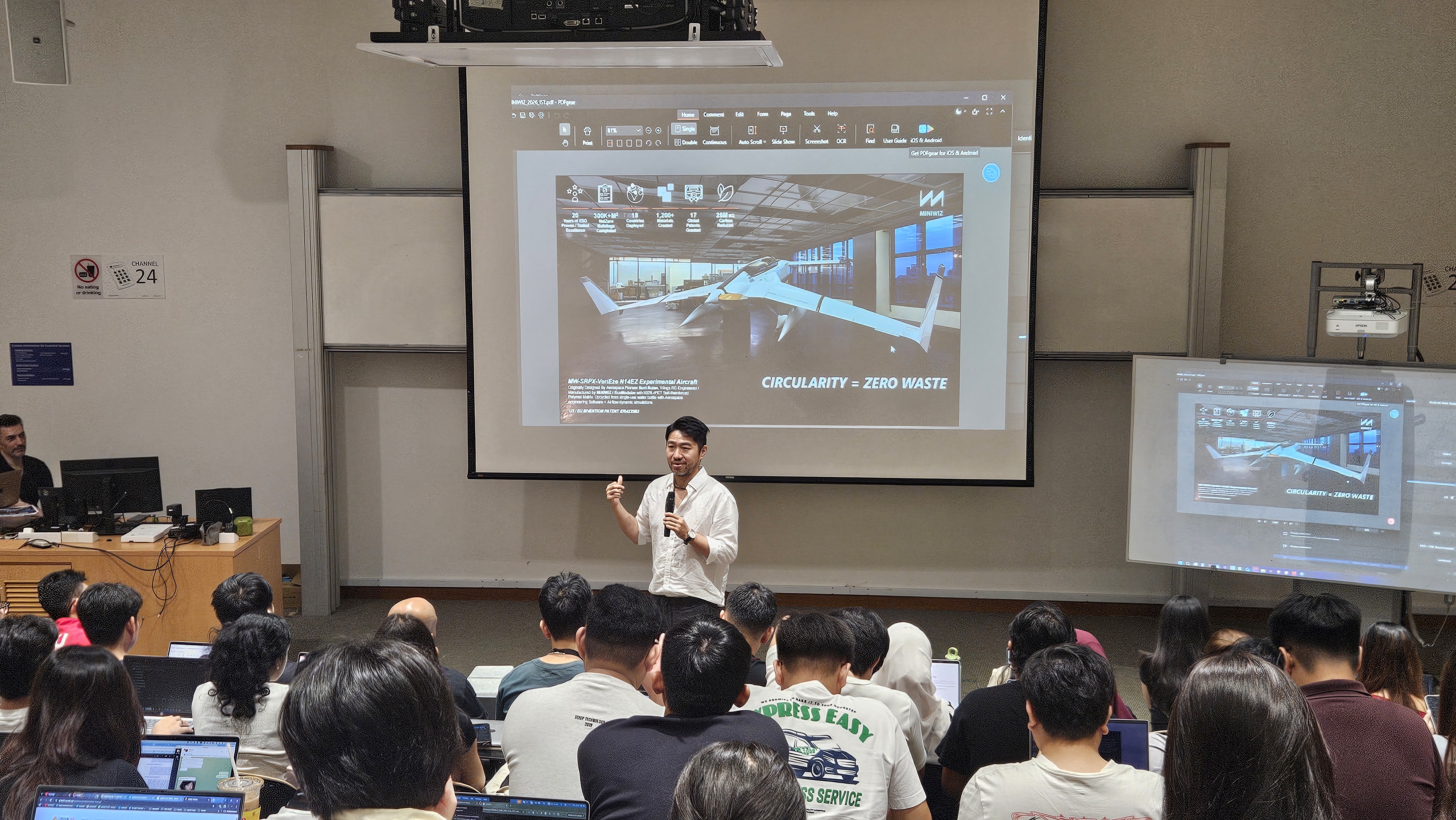
Day 4 of ASEAN Summer Track 1 program on Venturing into Entrepreneurship was a lecture by Mr Arthur Huang, CEO of Miniwiz, addressing students at Lecture Theatre 4 at School of Physics and Mathematical Sciences (SPMS) at NTU. His key message was that real entrepreneurship comes from deep personal involvement, disciplined thinking, and mining failure for insight rather than chasing novelty.
Arthur opened not with a pitch deck but with a story about a 48-year-old failed aircraft that used to sit in his office as a permanent reminder of Miniwiz biggest failure. Its wing design never worked, but the obsessive attention to how load and structure interlink, which the team pulled from that failure, went on to shape many of the company's later construction projects. This became his central lesson, "No failure is ever truly a failure", because whatever does not work still holds value if you are willing to extract it rather than bury it.
Maker or Taker?
From there, Arthur introduced a simple but sharp question for evaluating any venture: are you a maker or a taker? He used TSMC as an example, calling it "Taiwan defining maker identity" while acknowledging other factors that TSMC took to earn that recognition, through market share and monopoly power. His point was that every business does both, and founders need the self-awareness to name plainly what they are adding that did not exist before, and what they are extracting from someone else effort.
Let Necessity Define Your Ideas
He also urged students to let necessity, not novelty, define their ideas, testing any concept with one question: if this did not exist, would something actually break? Tracing his own thinking back to ancient Rome opus reticula tum, where engineers filled wall cavities with waste bound by cement to build structures like the Pantheon, Arthur explained that he looks for problems with proven precedent rather than fantasy solutions. He walked through how Miniwiz mapped its own why, where, and what before ever landing on recycling waste into building panels, cautioning that founders who chase a clever how too early usually skipped the groundwork.
The Trashpresso in Action
Finally, Arthur stressed repeatability, asking whether an idea could be done reliably more than once, the way a coffee machine can be duplicated a thousand times. Students got a firsthand look at the Trashpresso, Miniwiz solar-powered mobile recycling unit, at the Making and Tinkering Lab in SPMS, NTU. Compact enough to fit in the space of two industrial refrigerators, the machine turns plastic waste, from bottles to bottle caps, into usable tiles and construction materials in just minutes, needing only five bottles or fifty caps to produce a single tile.
Watching the process unfold live, rather than just hearing about it in a lecture, seemed to genuinely capture students' attention: seeing raw plastic waste get shredded, cleaned, and reshaped into something solid and usable made the abstract idea of a circular economy feel real and immediate.
Miniwiz built its business not on a clever product, but on the boring, missing data — collection, manufacturing, specification — that nobody else bothered to gather, because that kind of knowledge cannot be copied overnight. The key insight students took away was that no failure is wasted if you dive deep, exploring and understanding the mechanism behind it, and that old, proven solutions often hold more opportunity than seemingly new ideas. Overall, students learnt to evaluate ventures by asking whether they are truly necessary, whether they can be repeated at scale, and whether they build value or merely extract it.